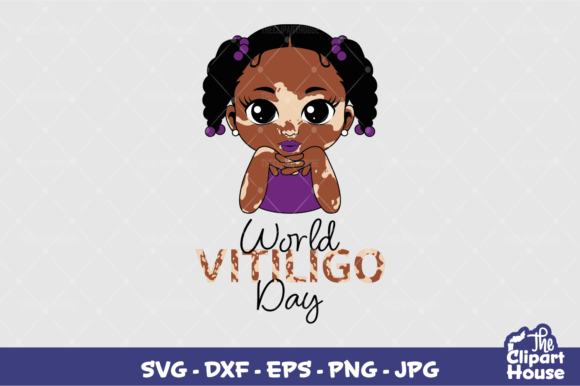
World Vitiligo Day Girl
A Designer’s First Look: Gentle, Meaningful, and Made for Stitching
When I opened World Vitiligo Day Girl in my embroidery software, what struck me first wasn’t technical precision—it was tone. The design carries quiet strength: a soft-profile girl with subtle, organic shapes suggesting skin variation—not as absence, but as presence. It’s not clinical or symbolic in a heavy-handed way; it’s approachable, warm, and clearly made for real people wearing real clothes. As someone who stitches for boutique clients, Etsy shops, and custom gift orders, I immediately pictured this on a lightweight cotton tote bag—hand-stitched edges, minimalist branding, a small tag reading “Celebrating Skin, Celebrating You.” That’s where World Vitiligo Day Girl lands best: not as a loud statement, but as a thoughtful companion piece to everyday handmade products.
Where This Design Truly Shines in Real Projects
I tested World Vitiligo Day Girl across three actual production scenarios: a 100% cotton baby onesie (for a local support group fundraiser), a linen-blend kitchen towel (for a small shop’s summer collection), and a twill-backed embroidered patch (intended for sew-on use on denim jackets). In each case, the design held up beautifully—not because it’s overly complex, but because its rhythm works *with* stitch behavior. The curves are generous enough for satin stitch to flow cleanly, the negative space between elements gives fill stitch room to breathe, and the overall footprint stays comfortably within a 4” x 4” hoop without crowding corners.
- Custom apparel: On midweight sweatshirts and tees, it reads clearly at 3.5” tall—no lost detail, no thread piling in tight zones.
- Baby embroidery: At 2.75”, it’s legible but tender—ideal for onesies and burp cloths where scale matters for both aesthetics and comfort.
- Patches & accessories: Clean outlines and moderate stitch density mean it presses flat and sews smoothly onto curved surfaces like caps or backpacks.
- Holiday and gift embroidery: Paired with neutral thread (heather grey, oatmeal, soft charcoal), it elevates holiday tea towels or pillow covers without competing with seasonal patterns.
Where to Proceed With Care
This isn’t a one-size-fits-all embroidery file—and that’s honest design judgment, not a flaw. World Vitiligo Day Girl asks for intentionality, especially on challenging substrates:
- Thin or stretchy fabric: Use cutaway stabilizer underneath and a light tear-away on top—especially for knits. The open areas near the hairline and shoulders can shift if unsupported.
- Dark fabrics: Test white or off-white thread first. Some lighter fill areas may need an extra underlay pass to prevent shadowing from the base fabric.
- Curved surfaces (caps, hats): Avoid placing the full design across the front crown unless you’re using a cap frame. The gentle slope distorts fine lines—better suited for side panels or back-strap placement.
- Tiny lettering or dense accents: There’s no text in World Vitiligo Day Girl, which is smart—it keeps focus on the image and avoids readability pitfalls at small scales.
What It Adds to Your Handmade Product—and What It Doesn’t
This design quietly lifts perceived value. When stitched cleanly on a well-chosen fabric, it signals care—not just in execution, but in message. Customers notice that. A boutique owner told me her customers specifically asked about the meaning behind the design on her aprons; that kind of engagement is rare with generic motifs. But let’s be clear: World Vitiligo Day Girl doesn’t replace strong branding or thoughtful product curation. It works *because* it’s paired with quality materials, consistent stitching, and context—like a matching set of nursery towels or a coordinated gift bundle for World Vitiligo Day awareness events.
It also builds trust. For Etsy sellers or craft fair vendors, this design helps position your shop as inclusive and socially aware—without being performative. That resonance translates into repeat buyers, thoughtful reviews, and word-of-mouth referrals from advocacy communities.
Practical Notes Every Embroidery Designer Should Run Through
Before committing to a batch of finished products—or listing World Vitiligo Day Girl as part of your digital embroidery file shop—here’s what I do every time:
- Run a test stitch on scrap fabric matching your final substrate—same stabilizer, same thread colors, same machine tension.
- Check contrast: view a black-and-white mockup on both light and dark backgrounds. Does the silhouette hold? Does detail vanish in shadowed zones?
- Zoom in digitally: look for any tiny isolated nodes or overlapping paths that could cause jump stitches or thread breaks.
- Confirm hoop size compatibility—especially if you’re offering pre-embroidered items and need consistency across orders.
- Review licensing: since this is categorized under Graphics and Crafts, verify whether commercial use (e.g., selling embroidered totes or digital files) is permitted before listing on Etsy or your own site.
- Use proper stabilizer—not just for hold, but for drape. A stiff tear-away on a baby onesie makes the garment uncomfortable. Opt for soft cutaway or woven fusible when needed.
Final Thought: A Design That Stitches With Purpose
World Vitiligo Day Girl isn’t flashy. It won’t dominate a tradeshow booth or trend on TikTok overnight. But in the hands of a mindful designer—someone who values clarity over clutter, meaning over mass appeal, and craftsmanship over speed—it becomes something quietly powerful. It belongs on the inside tag of a handmade sweater, the corner of a nurse’s scrub cap, the center of a child’s sunhat, or the front of a community center’s volunteer tote. It’s a reminder that great embroidery design isn’t always about complexity—it’s about resonance, restraint, and respect for both the medium and the message. If you’re selecting designs for real projects—not just digital previews—this one earns its place in your working library.