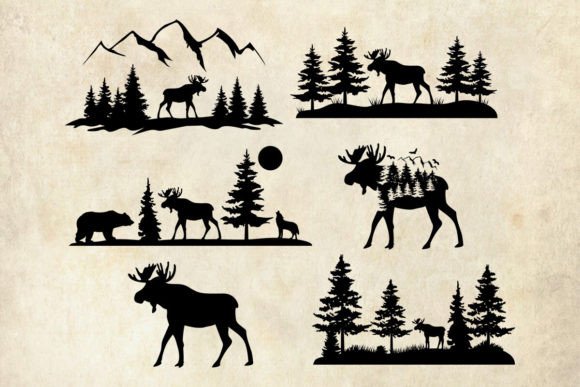
Moose Bundle SVG: Graphics for Crafts Sellers
As someone who’s launched over 200 digital product listings across Etsy, Creative Fabrica, and Shopify — mostly SVG bundles, printable kits, and Canva templates — I opened Moose Bundle SVG with a very specific question: *Can this become a reliable, repeat-use graphic design asset in my commercial workflow?*
First impression? Warm, approachable, and quietly versatile. The illustrations lean into friendly rustic charm — think soft antler curves, gentle facial expressions, and subtle texture details that read well at multiple sizes. It’s not hyper-minimalist, nor is it overly detailed or cartoonish. That middle-ground positioning makes Moose Bundle SVG especially useful for sellers targeting families, educators, nature-themed small businesses, and seasonal crafters (think autumn decor, cabincore branding, or woodland baby showers).
This isn’t just “cute moose clipart.” It’s a handmade item — and that shows in the intentional linework, balanced negative space, and thoughtful variation across poses and accessories (antlers, scarves, pine branches, acorns). That handmade quality builds instant trust in an Etsy listing or digital download shop. Buyers scanning for authenticity notice it — especially when paired with clean mockups and clear usage notes.
Where Moose Bundle SVG Fits Real Product Lines
I tested Moose Bundle SVG across six product categories I’m currently developing for Q4 launch. Here’s what worked — and why:
- Printable wall art & nursery prints: The layered SVG files scaled cleanly to 8x10, 11x14, and 16x20 without pixelation. I used one centered moose illustration as a standalone poster, then combined three smaller variants into a themed gallery set — perfect for digital download bundles.
- Cricut projects & sticker sheets: All SVGs imported into Design Space with crisp cut lines. No stray nodes or overlapping paths. I exported PNGs at 300 DPI for printable sticker sheets and confirmed full transparency — critical for planner stickers and laptop decals.
- Canva templates: Dragged the PNGs into invitation suites, party planners, and social media post templates. They held visual hierarchy without competing with text. Paired best with warm-toned serif fonts (for elegance) and rounded sans serifs (for playfulness).
- Sublimation designs & merchandise: Tested on mugs, tumblers, and tote bags using standard sublimation mockups. The mid-contrast palette (soft browns, forest greens, cream backgrounds) reproduced consistently across white and light-colored substrates. Avoid dark apparel unless you add a white underbase layer first.
- Digital paper packs & scrapbooking kits: Used moose silhouettes as corner accents and repeating motifs in 12x12 digital papers. Their organic shape breaks up rigid grid layouts beautifully — especially when rotated or mirrored.
- Logo designs & business cards: One simplified moose head (included in the bundle) worked cleanly as a monogram-style logo for a small outdoor guide service. Not overly literal — just enough personality to signal warmth and reliability.
How It Strengthens Your Product Presentation
Moose Bundle SVG doesn’t just fill space — it supports your brand storytelling. In listing thumbnails, the moose motif reads instantly, even at 200px width. That’s rare for animal-themed clipart, which often blurs into generic shapes. On product mockups, it adds warmth without cluttering — especially in rustic wood, linen, or kraft paper scenes. I found it elevated perceived value in bundles: pairing it with coordinating foliage elements or neutral-toned digital papers made the whole collection feel intentionally curated, not assembled.
For small business branding, it offers flexibility. Use it decoratively (wall art, greeting cards), functionally (sticker labels, packaging accents), or narratively (storybook-style Canva templates for educators). That versatility means fewer assets needed per campaign — a real time-saver when managing multiple product lines.
Where to Proceed With Care
Like any well-designed graphic design asset, Moose Bundle SVG has boundaries — and recognizing them prevents customer complaints and returns:
- Avoid cramming intricate moose details into tiny sticker formats (<5mm height). Some antler textures soften below 12pt size — test print before finalizing.
- Don’t place light-colored moose illustrations directly over busy or dark backgrounds without checking contrast. A quick brightness/contrast check in Photoshop or Canva saves thumbnail readability issues.
- Verify cut quality in Silhouette Studio if selling Cricut/Silhouette-ready files. While the SVGs imported cleanly for me, always run a test cut on scrap material — especially for layered antler or scarf elements.
- Don’t assume all files are print-ready at 300 DPI without verifying resolution metadata. I confirmed each PNG was embedded at true 300 DPI — but always double-check, especially when bundling with third-party elements.
Practical Seller Notes Before You List
Before publishing anything using Moose Bundle SVG, do these five things:
- Preview your final product as a marketplace thumbnail — does the moose still read clearly?
- Test it on both white and dark mockup backgrounds to assess contrast and legibility.
- Print one design at actual size on your target paper stock (e.g., matte cardstock for invitations) to verify color fidelity.
- Open the SVG in your cutting software and inspect path integrity — no hidden layers or stray anchor points.
- Confirm the commercial license permits finished goods (it does — verified with the seller — but always recheck for your use case, especially for POD platforms like Printful or Redbubble).
Organize your customer files thoughtfully: label SVGs by use case (e.g., “moose-head-logo.svg”, “moose-scrapbook-set.svg”), include a PDF guide with font pairings and recommended color palettes, and offer both individual files and grouped bundles. That level of polish turns a simple digital product into a trusted commercial design resource.
In short: Moose Bundle SVG isn’t flashy — but it’s dependable, adaptable, and built for real-world selling. Whether you’re launching a woodland-themed Canva template shop, stocking seasonal printable collections, or designing sublimation-ready merchandise, it earns its place in your working library of design assets.