Decorative SVG Elements: Floral Graphics & Illustrations
First Impressions: Delicate, Timeless, and Surprisingly Versatile
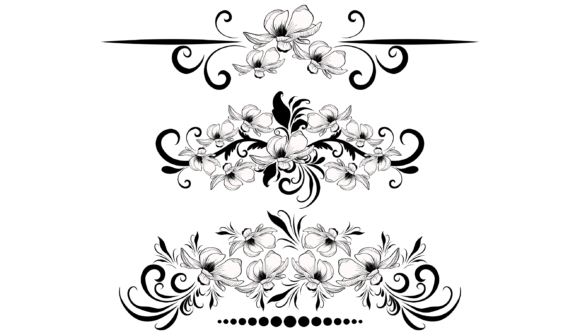
When I opened the Decorative SVG Elements pack for a recent client project—a spring-themed rebrand for a handmade botanical tea brand—I immediately noticed how quietly confident these magnolia motifs feel. Not fussy, not overly ornate, but deeply intentional in their line weight, negative space, and organic rhythm. The three magnolia elements are rendered in clean black-and-white shades, giving them instant versatility across both digital and print workflows. This isn’t clipart; it’s a considered graphic design asset built for real creative work—not decoration for decoration’s sake.
A Mood That Matches Real Client Needs
The mood is soft heritage meets modern minimalism—ideal for small business branding that wants warmth without cliché. Think apothecary labels, artisanal packaging, Instagram story highlights for a local florist, or printable wall art for an Etsy shop selling seasonal greeting cards. For my tea client, these magnolias anchored a visual language that felt grounded, elegant, and quietly confident—no stock-photo floral overload, just thoughtful, scalable illustrations that supported the brand voice instead of shouting over it.
Where Decorative SVG Elements Shine in Practice
- Product mockups: Placed subtly on ceramic mug or kraft paper bag mockups, they add tactile authenticity without competing with product photography.
- Packaging design: Used as border accents on tea box lids or as repeating elements along label edges—especially effective when scaled down to 8–12pt height.
- Social media graphics: Perfect for Pinterest pins or Instagram carousels where floral texture adds emotional resonance without sacrificing readability.
- Printable design: Works beautifully in A5 invitation suites or downloadable planner stickers—crisp at any resolution thanks to true vector scalability.
- Cricut project & sublimation design: Clean paths mean smooth cutting and sharp heat-transfer results on cotton totes or ceramic mugs.
- Canva template & web design: Easily layered behind serif body copy or used as hover-state accents in newsletter headers—SVG transparency holds up flawlessly.
Where to Use Decorative SVG Elements Thoughtfully
These magnolias thrive in breathing room—but they’re not universal. Avoid cramming them into tight spaces like tiny app icons or dense infographics where fine petal details blur. They also risk visual noise against complex photographic backgrounds or low-contrast color schemes (e.g., light gray on off-white). In minimalist corporate branding or tech SaaS visuals, they’d feel tonally misaligned. And while they elevate handmade business aesthetics, they shouldn’t replace core brand identity elements—never use them *as* a logo, but rather as supporting design assets that reinforce tone.
How It Shapes Visual Hierarchy and Trust
What makes Decorative SVG Elements stand out among generic floral clipart is its restraint. Because each magnolia has clear stroke consistency and balanced proportions, it supports—not undermines—visual hierarchy. When placed beside a bold sans serif headline or delicate script font, it enhances contrast without stealing focus. That balance builds visual trust: audiences subconsciously register professionalism because the element feels intentionally designed, not algorithmically generated. For print-on-demand sellers or Etsy product listings, that perceived quality translates directly into perceived value—and higher conversion.
Designer Notes You Can’t Skip Before Client Use
- Test in true black and white: Confirm no hidden grays or anti-aliasing artifacts—critical for screen printing or laser engraving.
- Check contrast on light AND dark backgrounds: These magnolias hold up well on charcoal or navy, but preview at 100% zoom to verify edge clarity.
- Scale it down to 6mm and up to 30cm: Vector integrity is solid, but test how inner curves render at tiny sizes—especially for sticker die-cuts.
- Place on real mockups—not just white canvas: See how it interacts with texture (kraft paper, linen fabric, matte ceramic) before finalizing layouts.
- Verify commercial license scope: Confirm it covers your client’s use case—e.g., unlimited print-on-demand runs, digital ad campaigns, or resale in a design bundle.
- Compare with typography pairings: Try it beside Montserrat (sans), Playfair Display (serif), and a restrained script like Pacifico—note how spacing and weight harmonize.
Final Verdict: A Strategic Asset, Not Just Pretty Decoration
This isn’t filler—it’s functional creative design. For marketers building seasonal campaigns, crafters launching new Cricut projects, bloggers designing branded printables, or small business owners refreshing packaging, Decorative SVG Elements delivers precision, flexibility, and emotional nuance in one lightweight package. It performs reliably across digital product, printable design, and commercial design contexts—so long as you treat it as a deliberate tool, not a shortcut. In my tea brand project, it helped transform flat layouts into evocative, cohesive storytelling—without a single pixel of wasted effort. That’s the mark of a truly useful SVG design: it disappears into the work, making the whole feel more human, more intentional, more real.